Exclusive: Vitamin°C emerges with €18m trans-Atlantic climate tech fund

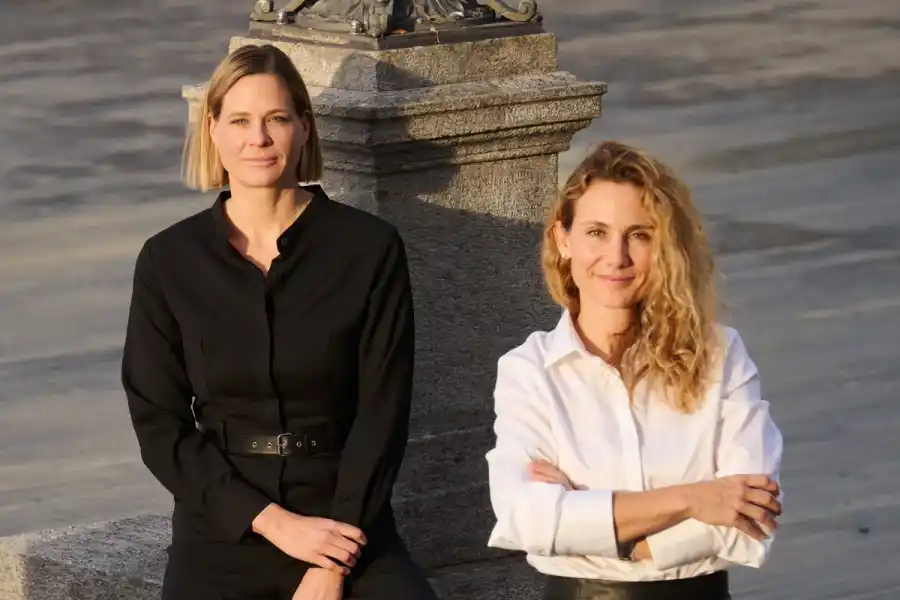
Vitamin°C founding partners Sophie Lamparter (left) and Nathalie Moral. Credit: Florian Kalotay

Two prominent Swiss impact investors have raised €18m for Vitamin°C, a new early-stage fund targeting US and European climate tech startups.<br><br>Anchored by a wealthy family whose father invented the smoke detector, the firm has revealed its first investment – and, fittingly, it’s in wildfire tech. <br><br>"In every crisis, there's opportunity," founding partner Nathalie Moral tells Impact Loop.

Managing editor
No items found.

Vitamin°C, co-founded by Nathalie Moral and Sophie Lamparter, has raised €18m in its first close as it looks to back climate tech startups on both sides of the Atlantic.

The fund is anchored by the Meili family office, run by brothers Martin and Daniel Meili whose father, Ernst Meili, invented the ionization chamber which became the foundation of the modern smoke detector.

The Meili brothers are fitting backers for Vitamin°C’s first investment – Satellites on Fire. The Argentina- and US-based startup uses satellite data and AI to provide early wildfire detection. The company is active in 19 countries and has grown to $300,000 in ARR within a year, according to Moral. It also fits firmly within Vitamin°C’s broader thesis.

Investing in climate resilience

Vitamin°C is making its public debut after operating in stealth since it started fundraising nine months ago. The fund takes its name from vitamin C's role in strengthening immune systems – a parallel the founders draw to building climate and human resilience.

"The name combines very well what the fund does," Moral, who was an early investor in Swiss carbon capture unicorn Climeworks, tells Impact Loop. "Vitamin C strengthens the resilience of our bodies, and Vitamin°C as a fund strengthens the resilience of the climate and humans."

VitaminºC will write €0.5m–€1.5m cheques into pre-seed startups, with a strong focus on climate adaptation, which focuses on building resilience against the effects of climate change that are already unavoidable. Each investment should demonstrate the potential to mitigate or remove at least 100,000 tons of CO2, or improve the resilience of 100,000 people within five years, say the partners.

VitaminºC has several planned investments in its sights, including in climate-resilient crops, energy efficiency solutions for AI data centres, and next-generation carbon removal technologies that upcycle CO2 into industrial products. It is also exploring a spin-out from ETH Zurich that has developed chemical recycling technology for rare earth metal recovery.

Doubling down on climate

While many generalist funds retreat from climate tech amid political headwinds, Vitamin°C is leaning in.

"In every crisis, there's opportunity," says Moral, who’s based in Zurich, Switzerland. "A lot of the funding that went in during 2021 blew up valuations. There's a healthy reset happening.”

Lamparter believes that global crises, including war and energy supply disruptions, act to bolster the fundamentals of climate tech investing.

"Climate technologies are going to be needed much more as we move forward,” she tells Impact Loop. “China is now running 52% of their economy on renewables – not because it's greener, but because it's more efficient and independent."

Moral will operate VitaminºC from Zurich while Lamparter will be based in San Francisco, where she has lived for the past 15 years. The partners believe the trans-Atlantic nature of the fund offers a number of advantages – if not a lot of early morning and late-night remote team meetings.

"There's a difference in speed and scale in the US, while Europe has massive potential in terms of IP and well-funded universities," explains Lamparter.

"We can help founders from Europe access US markets and funding early-on, and help American founders make the move to Europe to access talent or a more stable regulatory environment,” she says.

The partner says the fund’s target size will depend a lot on how quickly it is able to attract other forms of capital, beyond the existing cohort of family offices and private individuals.

"If we get bigger institutional investors on board, we'll aim to land at around €30-50m," Moral explains. "Otherwise we'll go quick and deploy fast with private investors only."

Get full access to Europe's new platform for impact news

  • Quality journalism, interviews, investor profiles and deep-dives
  • Daily newsletter with top stories, latest funding rounds and roundup to keep you in the loop
from €41/month
Save €189 per year (32%) compared to monthly billing.
Save 15% with a yearly subscription.
Already a subscriber? Log in

Keep reading – get in the loop!

  • Håll dig i loopen med vårt dagliga nyhetsbrev (gratis!)
  • Full tillgång till daglig kvalitetsjournalistik med allt du behöver veta inom impact
  • Affärsnätverk för entreprenörer och investerare med månatliga meetups
Thank you! Your submission has been received!
Oops! Something went wrong while submitting the form.

Fortsätt läsa – kom in i loopen!

  • Håll dig i loopen med vårt dagliga nyhetsbrev (gratis)!
  • Full tillgång till daglig kvalitetsjournalistik med allt du behöver veta inom impact
  • Affärsnätverk för entreprenörer och investerare med månatliga meetups
Thank you! Your submission has been received!
Oops! Something went wrong while submitting the form.