The impact startups that went bankrupt in 2025 – and what they can teach us
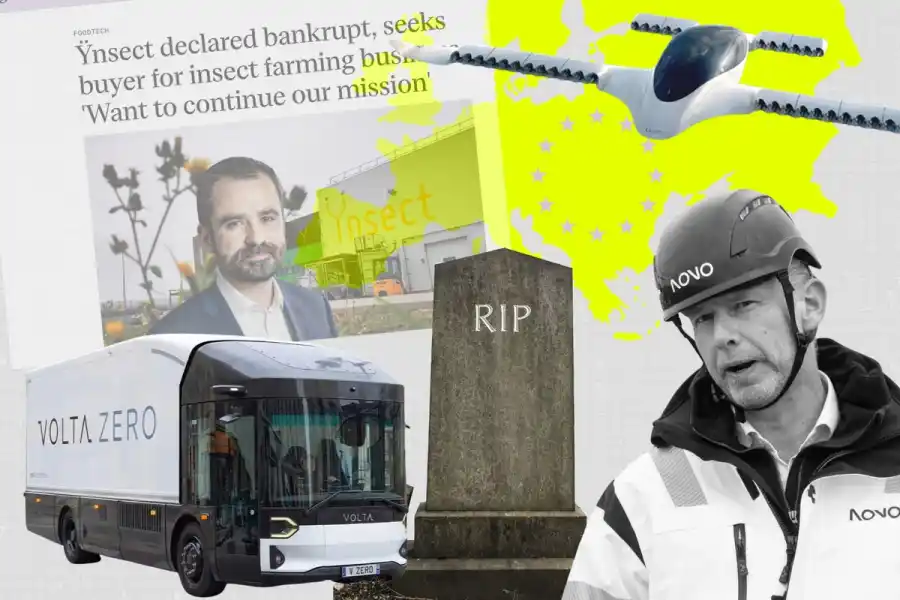
Record bets on Europe’s impact startups have turned into cautionary tales. <br><br>From batteries to foodtech, 2025 saw high-profile bankruptcies that offer hard – but valuable – lessons for investors and founders heading into 2026.
.png)
A few years ago, investors were making record bets on impact-focused startups, backing everything from next generation batteries to vegan bacon. Now, many of the those bets are coming undone.
Despite early optimism, scaling many clean technologies proved harder than expected. Political uncertainty, economic headwinds and rising interest rates pushed many investors away from climate hardware in particular. Some redirected capital toward software, AI and SaaS – bets perhaps seen as safer.
Europe’s impact startups have been hit by a sharp venture capital downturn, felt especially acutely in capital-intensive sectors such as climate tech, mobility, and foodtech.
These conditions set the stage for a wave of bankruptcies in 2025.
But there is also a harder truth that cannot be ignored – most startups fail. It is a brutal reality that founders and investors alike understand.
Still, failure does not end the story. With global challenges such as climate change, food security and poverty only intensifying, the opportunity and the need for ambitious solutions remains.
Largely, the investors agree that the market for climate tech remains vast. “The problems that were there before, are still there,” Zoe Peden, partner at Ananda Impact Ventures, recently told Impact Loop. “In fact they’re only getting worse.”
Here are some of the most notable bankruptcies in Europe’s impact space in 2025, and what founders and investors can learn from them going forward into the new year.
The fall of a battery champion
The biggest collapse of the year was Sweden’s Northvolt, which filed for bankruptcy in March 2025 after failing to secure additional funding.
Backed by roughly $15bn in public and private capital, Northvolt was meant to become Europe’s battery champion, a homegrown rival to Asian and US giants. Instead, it became one of the continent’s most expensive industrial failures.
In the aftermath, explanations came from all sides. Fierce global competition, overspending, alleged mismanagement, and insufficient state support were all cited. Northvolt itself pointed to rising capital costs, geopolitical instability, and supply chain disruptions, compounded by internal challenges in scaling production.
One clear takeaway is that Europe should think carefully before trying to compete head on with Asia on low cost lithium-ion batteries, a race many believe is already lost.
Former CEO Peter Carlsson has since reflected that Northvolt relied too heavily on bank financing and tried to scale too quickly before its operations were fully ready.
“When you're building something new, you will have to change suppliers or your product mix," he said at Norrsken Impact Week in Barcelona last year. "And every time you do that, you need to ask for the approval of your financing community, which can be 15 banks."
That slows you down rather than letting you make the right decisions, he said. “I do think there is a need for project financing 2.0."
Mobility hits the brakes
During the pandemic era, investors poured money into electrifying just about everything that could move. That included e-scooters, e-bikes, e-trucks, e-boats and even e-planes.
In 2021, European mobility startups raised more than $3bn. By 2025, that figure had fallen to less than a third and a long list of startups had run out of road.
Among the highest profile casualties was German electric aircraft startup Lilium, which filed for bankruptcy for the second time in February 2025.
At its peak, Lilium employed more than 1,000 people and had raised over $1bn from investors including Atomico, LGT Capital Partners and Tencent. In 2021, it went public via a SPAC at a $3.3bn valuation.
That money evaporated into the development of its electric vertical take off and landing aircraft (eVTOL), and eventually investor appetite dried up.
Lilium’s founders and leadership have largely pointed to a failure to secure funding in time, alongside a loss of founder control and investor driven decision making.
“On a pure personal note, reflecting on the past events, I want to share one new key learning with my fellow founders: Never give away control of your own start-up. Never,” Lilium co-founder Dr. Patrick Nathan wrote on LinkedIn at the time.
Analysts have added other factors such as overly ambitious technology, the difficulty of certifying a new aircraft design, and the enormous capital runway required to bring such a aircraft to market.
A lesson? Convincing governments and financiers to back a technically complex aircraft that takes years to certify and initially serves a premium market is a hard sell, especially in uncertain economic times.
Lilium has not been alone. Electric truck maker Volta Trucks filed for bankruptcy for the second time in May, while electric boat company X Shore later shut down its production arm.
Foodtech fallout
A few years ago, foodtech startups promised to reshape our diets with everything from cultivated meat to vegan cheese. In practice, changing how people eat and what they are willing to pay for has proved far harder.
The most high profile collapse in the sector was French insect farming startup Ÿnsect, which was declared insolvent in December after months of financial turmoil.
Founded in 2011, Ÿnsect raised more than $600m from investors including Astanor Ventures, Bpifrance and the European Institute of Innovation and Technology. Its plan was to farm mealworms at scale and turn them into animal feed, pet food, and fertiliser.
The company struggled to compete with established players on cost, particularly in animal and pet feed markets. It is also widely seen to have scaled too aggressively. Everything was done "too big, too fast, all at once," former employee Hadrien Godard told AFP after sweeping layoffs.
One lesson is not to rely on green premiums, especially in price sensitive markets like animal feed, where sustainability rarely outweighs cost.
Elsewhere in the sector, Dutch cultivated meat startup Meatable abruptly shut down in December after failing to secure fresh funding. Swedish vegan cheese maker Stockeld Dreamery ceased operations in October. Another Dutch company, Vegan Finest Foods, declared bankruptcy after demand for its plant based products slumped.
Dr. Nadine Geiser, a specialist agrifood tech investor at World Fund, says we’re witnessing a reckoning in the foodtech sector that has laid bare its crucial shortcomings, especially in the plant-based sector.
“The first wave of plant-based hype has fizzled,” Geiser told Impact Loop in October. “That’s partly because of overpromising and underdelivering on product quality.”
She points to issues in the first batch of alt-protein products such as strong off-tastes, digestion problems, and poor texture – all that with a high price tag to boot.
“For a food tech business to thrive, the product has to be exceptional, and you need to deliver on consumer experience, not just storytelling,” she says.
Get full access to Europe's new platform for impact news
- Quality journalism, interviews, investor profiles and deep-dives
- Daily newsletter with top stories, latest funding rounds and roundup to keep you in the loop
Keep reading – get in the loop!
- Håll dig i loopen med vårt dagliga nyhetsbrev (gratis!)
- Full tillgång till daglig kvalitetsjournalistik med allt du behöver veta inom impact
- Affärsnätverk för entreprenörer och investerare med månatliga meetups
Fortsätt läsa – kom in i loopen!
- Håll dig i loopen med vårt dagliga nyhetsbrev (gratis)!
- Full tillgång till daglig kvalitetsjournalistik med allt du behöver veta inom impact
- Affärsnätverk för entreprenörer och investerare med månatliga meetups


