


Pilot-turned-founder claims airships are cleaner than trains – and has data to back it up
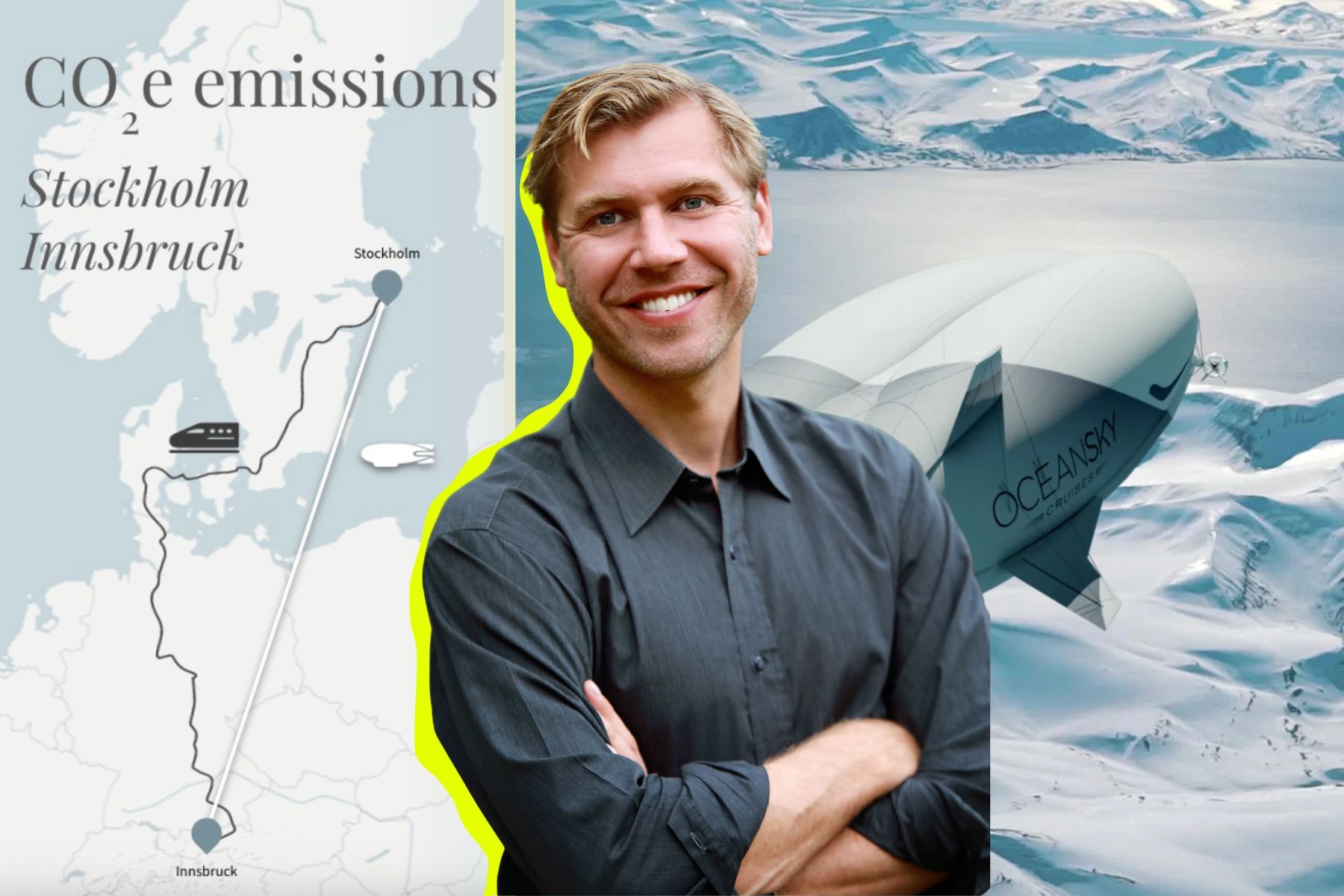
Can airships rise above trains on comfort, speed, and emissions? A new study suggests it’s possible, and Swedish startup OceanSky wants to make it a reality. But there's still a very long journey ahead.
.png)

Carl-Oscar Lawaczeck has spent over a decade as a commercial aircraft pilot, but his latest mission floats at a different altitude. He’s the founder of OceanSky Cruises – the world’s first airline for airships.
The Stockholm-based company believes Zeppelins could become one of the cleanest forms of travel in the future – and has numbers to back up the claim.
A new Life Cycle Assessment (LCA) commissioned by OceanSky and produced by engineering consultancy Tyréns claims that a large hydrogen-powered airship could emit just 10 grams of CO2 per passenger-kilometre – less than the average Nordic electric train.
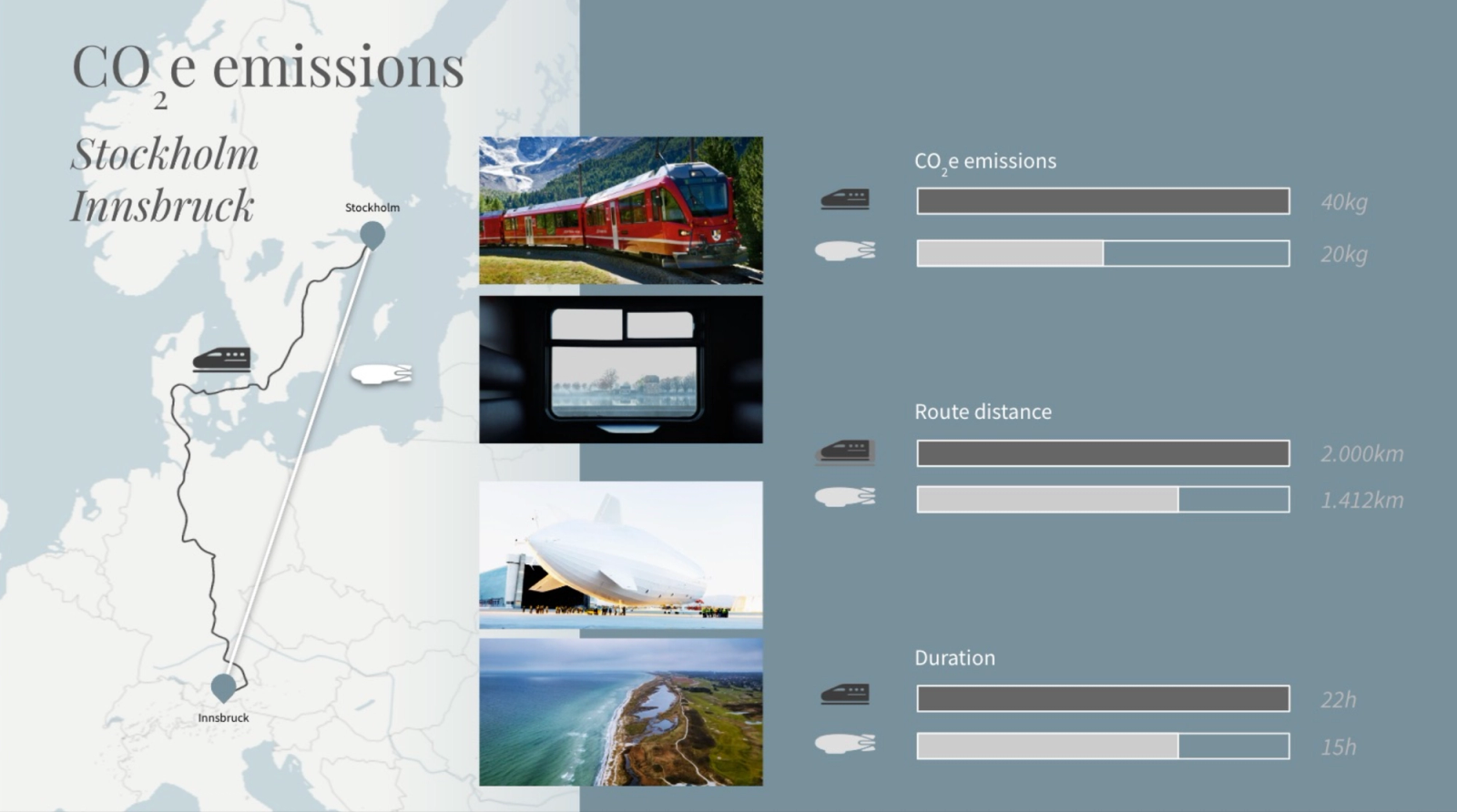
If powered by green hydrogen – produced using 100% renewable energy – that number could drop to 3 grams. For comparison, commercial jets spew between 133 and 298 grams.
“Airships have huge potential as a low-carbon transport option for travellers, but also to deploy cargo in remote regions,” Lawaczeck tells Impact Loop.
The Tyréns study is based on a 200-metre-long rigid airship with room for more than 100 passengers, powered by hydrogen fuel cells.
However, the report, while promising, is grounded largely in hypotheticals. Only a handful of airships have been built this century, and none of them run solely on hydrogen. Most currently run on jet fuel, erasing a large portion of the environmental advantage over commercial planes.
“The airship [used in this study] is still in a conceptual phase,” Tyréns writes in the report. “Material choices, fuel consumption, and potential locations are not fully known. Caution should therefore be exercised when interpreting the results.”
Lawaczeck doesn’t dispute that. “We’re basically creating a whole new industry here…there are still a lot of uncertainties, but we believe in the potential,” he says.
‘Lufthansa for airships’
OceanSky, founded in 2014, doesn’t actually build airships – it’s positioning itself to operate them, once the manufacturers catch up.
“Our mission is to become the airline of airships, like what Lufthansa is for Boeing, for example,” Lawaczeck tells Impact Loop. “Our role right now is to support and accelerate the industry by finding the business models.”
Despite having no airship, yet, OceanSky has 13 fully-booked flights for its first route – a two-day round trip from Svalbard to the North Pole. Each “cruise” will host approximately 16 passengers. It’s no budget adventure though – tickets are priced at $200,000 per cabin. Many of the passengers are also investors, taking an equity stake in the company.
Lawaczeck hopes that these initial luxury flights will provide a financial runway for the development of the airship industry, allowing it to scale quickly and then lower its costs.
“The first generation of airships will be pretty expensive,” he admits. “They’re costly to build, but as they grow larger, the cost per passenger falls dramatically – similar to container ships.”
The founder says the “breaking point” for economic viability is a 350-metre airship, large enough to rival today’s long-haul flights on cost.
“Once we reach that size, we can compete with existing travel options,” Lawaczeck says.
OceanSky is currently in talks with all major airship developers to secure its first aircraft, according to Lawaczeck, but he refused to name names citing non-disclosure agreements (NDAs).
Rising to the challenge
Some of the more advanced airship startups globally include US-based LTA Research, French startup Flying Whales, the UK’s Hybrid Air Vehicles (HAV). All of them could, hypothetically, be what Boeing is to the airline industry.
Of those three contenders, HAV and LTA Research have already built flying prototypes. LTA, founded by Sergey Brin, the former president of Google’s parent company Alphabet, and one of the richest people, conducted a series of test flights this year over the Bay area. HAV, whose hybrid craft is aptly nicknamed ‘the flying bum’, did its first test flight in 2016, but has been struggling recently with cash flow.
“The first airship that comes online, if it’s suitable, will get the job,” says Lawaczeck.
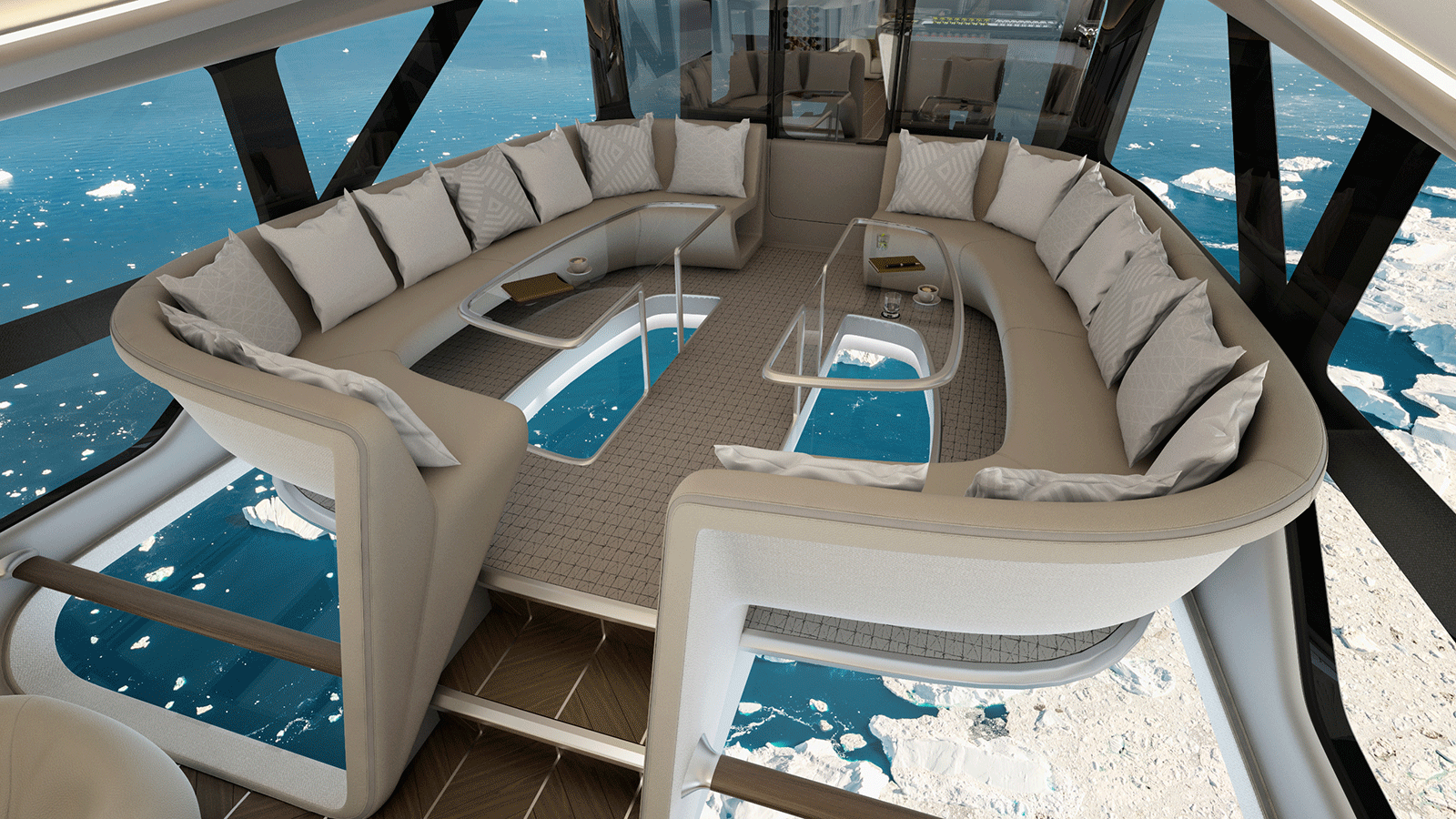
If that comes to pass, a trip from Stockholm to southern Spain could look like this: a 36-hour journey gliding low over Europe, the Alps rising close beneath panoramic windows. You’d have a cabin with a bed and desk, Wi-Fi for work, and space to stroll around a glass-walled lounge while sipping coffee. There are no roaring engines or cramped seats – just the slow hum of electric propellers and views no plane could ever offer. And all this while potentially emitting less carbon than cars, planes, and even trains.
“It’s comfortable instead of fast – and it’s environmentally friendly. It’ll be completely unique from anything we’re used to. And I believe it will be better.”
Get full access to Europe's new platform for impact news
- Quality journalism, interviews, investor profiles and deep-dives
- Daily newsletter with top stories, latest funding rounds and roundup to keep you in the loop
Keep reading – get in the loop!
- Håll dig i loopen med vårt dagliga nyhetsbrev (gratis!)
- Full tillgång till daglig kvalitetsjournalistik med allt du behöver veta inom impact
- Affärsnätverk för entreprenörer och investerare med månatliga meetups
Fortsätt läsa – kom in i loopen!
- Håll dig i loopen med vårt dagliga nyhetsbrev (gratis)!
- Full tillgång till daglig kvalitetsjournalistik med allt du behöver veta inom impact
- Affärsnätverk för entreprenörer och investerare med månatliga meetups