

Portuguese climate tech is having a breakout moment – and investors are taking note: 'The opportunity is kind of insane'
For years, Portugal has watched as its best scientists, engineers, and entrepreneurs flock to northern Europe seeking bigger markets and higher wages. <br><br>But something is slowly shifting – diaspora founders are coming back, international startups are setting up shop, and venture funding for climate and deep tech is at near-record levels. <br><br>Whether the ecosystem can hold onto that momentum is the million-dollar question.
.png)

Luísa Cruz left Portugal in her twenties with a biochemistry degree and a feeling that the country didn't quite have a place for her yet. She spent 14 years in the Netherlands – earning her PhD, then working at a large industrial biotech company – before an opportunity drew her back to her home country. In 2022, she returned to Lisbon as co-founder and CTO of MicroHarvest, a Hamburg-and Lisbon-based startup developing a bacteria-based protein using precision fermentation technology.
"It's much, much easier to find qualified talent in Portugal than in Germany," Cruz tells Impact Loop. "Much easier."
Cruz is one of a growing number of Portuguese engineers and scientists returning home from years abroad to start businesses in the country.
Rita Sousa and Carlos Esteban, two investors at Lisbon-headquartered climate and deep tech venture capital firm Faber, have watched that pattern repeat enough times that they've built it into how they source deals.
"We work a lot with diaspora founders," Sousa says, referring to Portuguese researchers and engineers who left for PhDs or careers abroad and return to build companies, often keeping headquarters in larger markets while anchoring R&D in Portugal.
"They know the ecosystem well, they know how to leverage the access to talent, while keeping the headquarters based outside," she tells Impact Loop.
However, it’s not only Portuguese that are starting businesses in the country. Joining them are growing numbers of foreign tech workers and entrepreneurs, drawn by an attractive lifestyle, a high level of English proficiency, and a lower cost of living than in the US or northern Europe.
Sousa points to the breadth of the engineering pipeline – mechanical, materials science, electronics, biotech, AI – as one of Portugal's most consistent draws.
"We have a very good basis of technical universities that provide a very good pool of talent available for the startups that exist here, and for international companies that want to leverage what Portugal can do best,” she says.
Portugal has also become a uniquely favourable location for companies to stress-test their technologies before expanding to bigger markets.
A testbed for clean technology
CorPower Ocean, a Swedish wave energy startup, has set up its manufacturing and R&D centre in the coastal town of Viana do Castelo, north of Porto. With access to some of the highest waves in Europe, it is running what it describes as the world's most advanced commercial-scale wave energy demonstration, backed by a €40m EU Innovation Fund grant.
Meanwhile, Gazelle Wind Power, an Irish company developing hybrid floating offshore wind platforms, moved its headquarters to Viana do Castelo entirely in 2024. Ponda, a UK-based biomaterials startup developing a plant-based alternative to down insulation, used Portugal's textile manufacturing cluster for its earliest pilots, iterating close to its target industry before moving to larger markets.
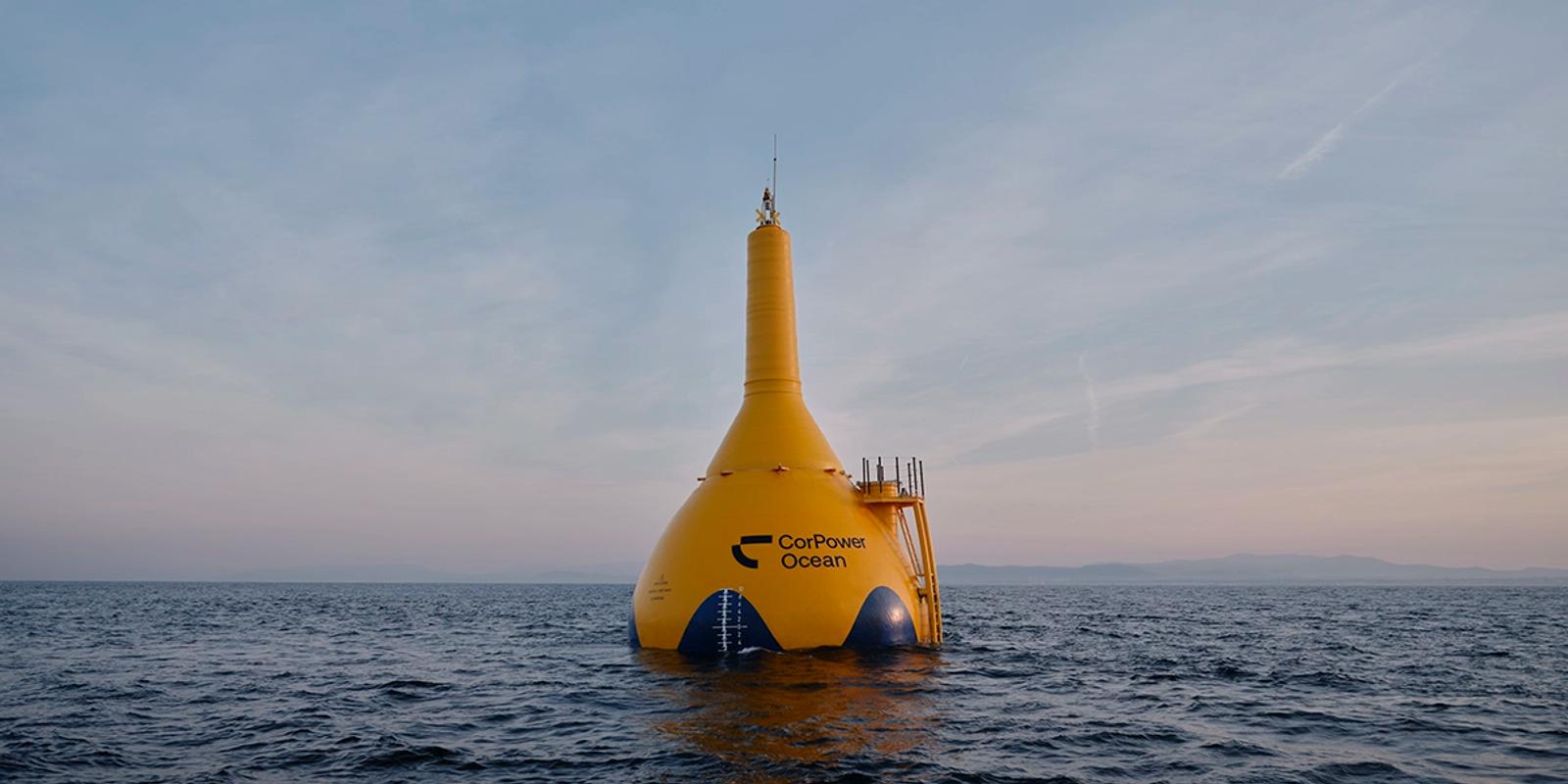
CorPower Ocean’s C4 Wave Energy Converter offshore in northern Portugal. Credit: CorPower Ocean
Cruz sees Portugal’s geography as an obvious asset for climate technology more broadly. "Portugal – the opportunity is kind of insane," she says. "We have both this huge ocean that we can work with and the sun and the winds."
Portugal has more Atlantic coastline than almost any country in Europe, one of the continent's best climates, and universities producing engineers that companies in Berlin, Amsterdam, or London have been poaching for years.
Esteban, who himself left Portugal to work abroad for many years, and now lives in Barcelona, also points to another reason why the country is attractive for tech companies.
"If you go to Germany, Sweden, UK, salaries and everything is more expensive – you need to put one more zero to everything," he says. "But in Portugal you can find hidden gems."
Some of those gems have been attracting significant capital in recent years, both from Portuguese and foreign investors.
A growing ecosystem
Eneida, a Coimbra-based grid optimisation software company founded in 2012, raised a €10.5m Series B in 2024, backed by Belgian family office Korys, HCapital Partners, Junction Growth Investors, and Santander Alternative Investments.
Oceano Fresco, a bivalve aquaculture company based in Nazaré, raised €17m in 2024 from Aqua-Spark, Indico Capital Partners, BlueCrow Capital, and Banco Português de Fomento. Meanwhile, Bling Energy, a Lisbon-based solar solutions company founded in 2022, raised €15m from BlueCrow Capital in August 2025.
There have also been a few clean exits from the Portuguese ecosystem, including energy software startup Cleanwatts which was acquired by German asset manager DWS in February.
Portugal's tech ecosystem attracted $427m in venture funding in 2025 – its second-highest total ever, behind only the $479m raised in 2021, according to Dealroom. More than $200m of that went to climate and deep tech companies.
For investors paying attention, Portugal’s impact ecosystem is starting to look like an emerging opportunity. But there are some big caveats.
What's still holding it back
Neither investors nor founders are uncritical of the ecosystem.
Cruz is candid about the friction of actually setting up a company in Portugal. "It was not super easy to formalise, to build up the company," she says. "The paperwork – I know there was a huge effort to simplify it, but it's not there yet. We really had to hire a consultant to support us."
Hiring international talent has added complexity too, with immigration permit delays creating problems for employees trying to travel. "We had situations where a person could not leave Portugal to visit parents," she says.
The gap Sousa returns to most consistently is non-dilutive funding. Compared to Germany, France, or the Nordics, Portuguese startups have significantly less access to grants at the pre-seed and seed stage – the point where founders need capital to build prototypes and validate technology before institutional investors come in.
"Startups in Portugal need access to a lot more early-stage capital," she says. "And I think that's something we could do better."
Esteban points to a related problem: the distance between scientific output and commercial application.
"We generate a lot of science but we don't know what to do with this in many cases," he says. The path from publication to patent to fundable company remains inconsistent. While improving, says Esteban, it still lags behind Northern European equivalents.
Then there is the question of wages. Portugal has some of the lowest wages in Europe, with a minimum wage of just €920 per month. That, coupled with a drastic increase in cost of living in recent years, continues to push locals to look abroad for opportunities.
Cruz says she would like to see the government sell Portugal on the quality of its talent, not the cheapness of it.
She is, however, cautiously optimistic about the future. When she left Portugal for the Netherlands, entrepreneurship was barely discussed at university level.
"I see a huge positive development in having entrepreneurship courses and talks now at university level," she says. But keeping talent in the country still remains a big hurdle.
"A lot of students at university level already assume they're going to go abroad," she says. "It's still just a few that think, okay, maybe I really can do this here [in Portugal]."
Get full access to Europe's new platform for impact news
- Quality journalism, interviews, investor profiles and deep-dives
- Daily newsletter with top stories, latest funding rounds and roundup to keep you in the loop
Keep reading – get in the loop!
- Håll dig i loopen med vårt dagliga nyhetsbrev (gratis!)
- Full tillgång till daglig kvalitetsjournalistik med allt du behöver veta inom impact
- Affärsnätverk för entreprenörer och investerare med månatliga meetups
Fortsätt läsa – kom in i loopen!
- Håll dig i loopen med vårt dagliga nyhetsbrev (gratis)!
- Full tillgång till daglig kvalitetsjournalistik med allt du behöver veta inom impact
- Affärsnätverk för entreprenörer och investerare med månatliga meetups