

The debate over founder lifestyles has a new flashpoint. <br>
.png)

Nordic entrepreneurs are pushing back against a trend that has gone viral in Silicon Valley – that founders should stay single until they raise a Series B.
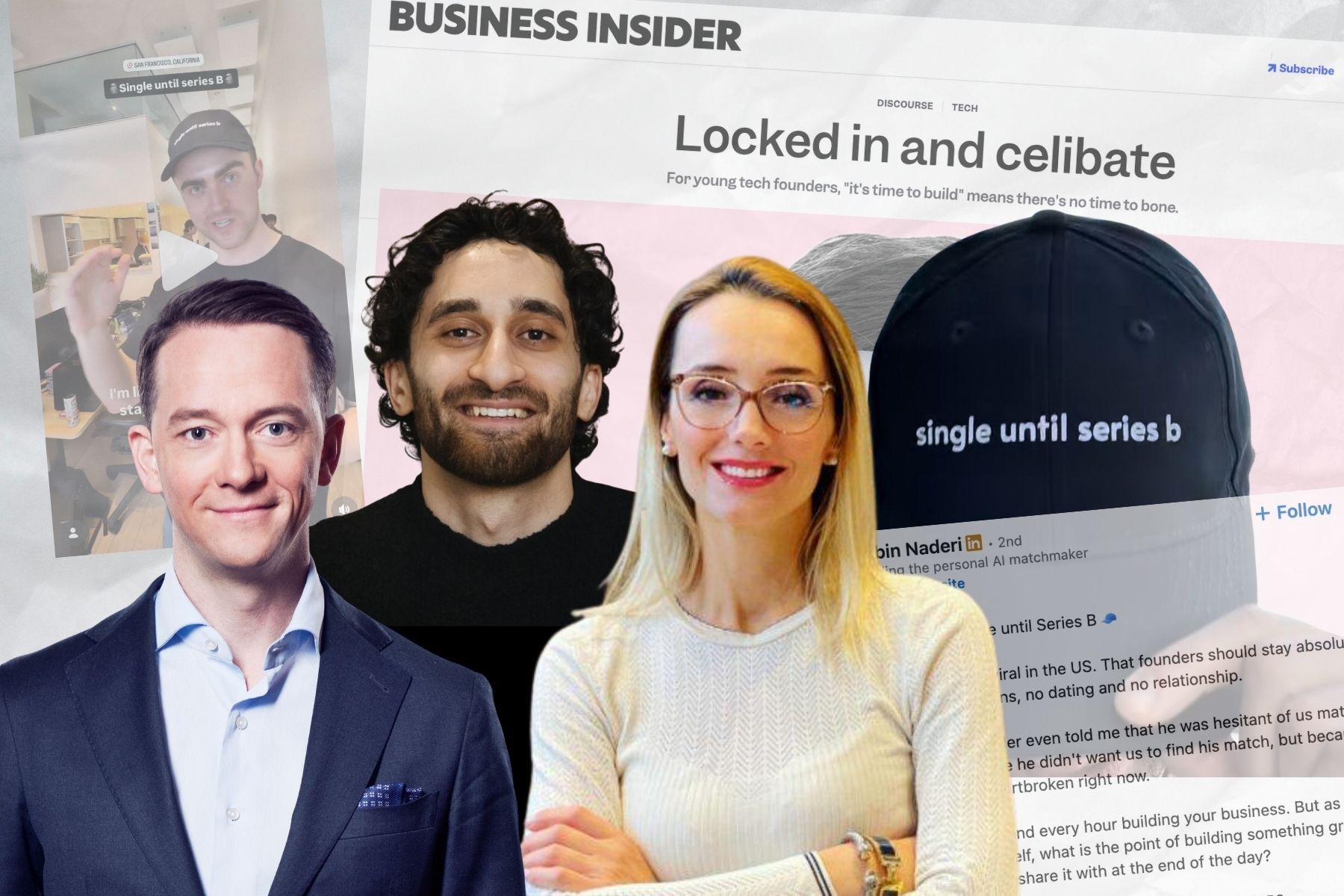
Rebin Naderi, founder of Stockholm-based AI matchmaking service Mia Matchmaking, posted the provocation to LinkedIn this week, framing it as the latest import from US hustle culture.
"I recently saw this take go viral in the US," he wrote. "That founders should stay absolutely locked in, with no distractions, no dating, and no relationship."
Naderi said the mindset had already reached Europe. An early-stage founder had told him he was hesitant to let Mia match his co-founder – not because he objected to the idea, but because he couldn't risk having him heartbroken mid-build.
"And I get it," Naderi wrote. "You want to spend every hour building your business. But at some point you have to ask yourself, what is the point of building something great if you don't have someone to share it with at the end of the day?"
The irony of Naderi's post is not lost: his entire business depends on founders – and everyone else – wanting to find a partner. Nevertheless, the replies to Naderi's post indicate a general disillusionment with tech's "grindset" narrative.
The pushback
"This is legitimately dumb," commented Jasper Mills, co-founder of Stockholm-based AI startup Ethira.
Andreas Lundmark, CEO and co-founder of Berget AI, was blunter still. "If you put all important things in life on hold until all the other things are in place, you will end up being 50, alone, and – looking at the statistics for successful exits – probably poor,” he wrote.
Aida Lutaj, founder and CEO of Legitify, reframed the whole premise. "A relationship has mood swings, misalignment, trust, repair, long time horizons, and no guaranteed outcome," she wrote. "In other words: very founder-relevant training data. If heartbreak knocks you out, good luck with a seed round. If conflict destabilises you, Series B will eat you alive."
Mikael Knutsson, a software engineer at Lovable, called out the underlying logic. "Strong 'late stage capitalism' vibes – the idea that better results is a pure function of hours per day spent," he wrote, adding that for many founders, time outside work is where real breakthroughs happen.
Not everyone disagreed with the premise, though. Martin Weigert, founder and curator of Swedish Tech News, offered a measured concession. "Kinda agree, actually. Seems impossible to be fully present for a partner – physically and emotionally – while one's mind is completely occupied with building the startup."
Latest Silicon Valley export
The post landed in the middle of a documented trend. In January, Business Insider reported that young tech founders across Silicon Valley had deleted their dating apps, declined nights out, and gone what they call "monk mode" – postponing intimacy until some future milestone, whether Series A, Series B, or exit.
One 27-year-old founder told the outlet he viewed a romantic relationship as "another startup in need of angel-round financing." An 18-year-old dropout founder said his social circle was his startup team and his entertainment was the dopamine rush of fixing bugs.
Couples therapist Daniel Dashnaw, writing in January, coined a term for it: “instrumental celibacy” – the deliberate postponement of dating and intimacy not for spiritual reasons, but as a productivity strategy, treating relationships as a discretionary cost to be resumed after hitting career milestones.
Dashnaw's own analysis cuts against the monk mode consensus. Being in a good relationship, he argued, frequently improves founders' work – support stabilises stress, and a partner outside the startup interrupts distorted internal feedback loops. Relational skills, he warned, don't stay in suspension while someone builds a company. "They either develop or they decay."
The broader 'hustle culture' debate
The debate is the latest in a series of clashes over how far founders should subordinate their lives to their companies.
Last year, Harry Stebbings, the 29-year-old founder of 20VC, argued that "7 days a week is the required velocity to win right now" for European founders – drawing immediate backlash. Index Ventures partner Martin Mignot backed the 996 model – working 9am to 9pm, six days a week – drawing comparisons to Chinese tech culture that critics noted is illegal in several European jurisdictions. Revolut CEO Nik Storonsky had made similar waves in March, arguing European founders weren't working hard enough and valued work-life balance too highly.
That conversation produced its own pushback. Suranga Chandratillake, general partner at Balderton Capital, called relentless hours "bad advice." "Even sprinters don't sprint all the time," he said. "Building a successful company is a marathon – it takes endurance."
A survey of 128 European founders by VC firm Antler last year found three-quarters work more than 60 hours weekly, with almost 20% exceeding 80 – challenging the premise that European founders lack the grindset to compete.
Whether the 'single until Series B' take gains the same traction as 996 remains to be seen. But Naderi's post suggests the conversation has already crossed the Atlantic.
Get full access to Europe's new platform for impact news
- Quality journalism, interviews, investor profiles and deep-dives
- Daily newsletter with top stories, latest funding rounds and roundup to keep you in the loop
Keep reading – get in the loop!
- Håll dig i loopen med vårt dagliga nyhetsbrev (gratis!)
- Full tillgång till daglig kvalitetsjournalistik med allt du behöver veta inom impact
- Affärsnätverk för entreprenörer och investerare med månatliga meetups
Fortsätt läsa – kom in i loopen!
- Håll dig i loopen med vårt dagliga nyhetsbrev (gratis)!
- Full tillgång till daglig kvalitetsjournalistik med allt du behöver veta inom impact
- Affärsnätverk för entreprenörer och investerare med månatliga meetups