This startup is quietly building a sovereign alternative to the US cloud – from a discreet site in Sweden
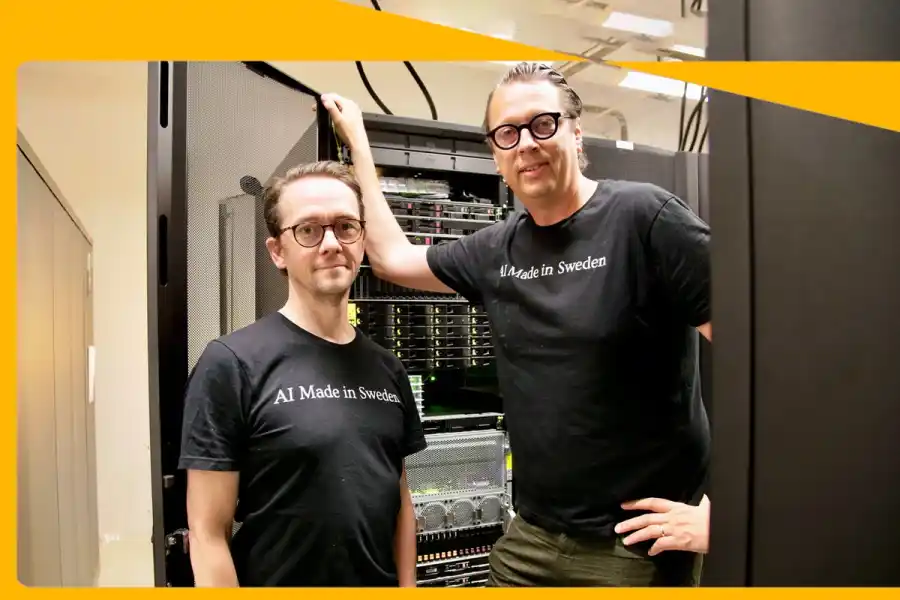
Operating largely out of sight in Kista, Sweden's new deeptech hub, a small team is working on what it hopes could become a key piece of Sweden’s future AI infrastructure.<br><br>"We want to prove that you can build AI in a secure and sustainable way," says Christian Landgren, co-founder of Berget AI.

This is a paid collaboration with Kista Limitless. Want to get to know Kista as an innovation hub? Check out the new kista.io!
When it comes to AI, the regulatory environment in Sweden is complex – spanning GDPR, the Data Privacy Framework and stringent security requirements for public documents and critical infrastructure. For many public authorities, municipalities and organisations in healthcare and finance, sending sensitive data to servers in the United States is simply not an option.
"Many organisations want to run AI in their systems or applications, but they’re not allowed to send data abroad. As a result, development teams often can’t use AI at all today, which slows innovation and business development. That’s why we wanted to create a Swedish alternative to the major cloud providers," says Christian Landgren, co-founder and chief technology officer at Swedish AI firm Berget AI.
Landgren founded the company in 2024 with CEO Andreas Lundmark. Coming from consultancy backgrounds, they shared a frustration with bottlenecks and the lack of practical solutions, which eventually led them to start the company.
"In the beginning we wondered why we were the only ones doing this – had we missed something obvious? But the customers speak for themselves. Clearly, there’s enormous demand," Lundmark says.
Sweden's central bank among the earliest to join
Berget did not remain a fledgling startup for long. One of its very first customers was Sweden’s central bank, the Riksbank. Since then, growth has accelerated sharply and the founders now count around 300 customers.
"Many are public authorities and municipalities, but we also work with startups serving those sectors," Landgren explains.
Berget’s first product offering is a suite of AI services that run entirely on its own servers in Kista. All data is encrypted and remains within Sweden’s borders. This setup enables clients to deploy large open-source language models – including those from US-based OpenAI, France’s Mistral and two Chinese model families. Sweden’s KB-Whisper model, developed by the National Library, is also proving popular. The crucial point is that everything operates on local infrastructure.
"We’ve designed the service directly from the authorities' checklists. That means we can sit down with a municipality’s IT experts and they suddenly find themselves able to say yes to an AI service. It almost creates a sense of surprise in the room."
Is the main aim to let them test new solutions?
"Not exactly. In many cases they’ve already carried out tests using synthetic data, and at that stage it doesn’t matter where the servers are located. But once they move on to a proof of concept, the questions around data security begin – and if they can’t answer them, the project doesn’t go any further."
Although the regulations are strict, Landgren argues they rest on a sound premise.
"In a crisis situation there can be no uncertainty about which countries might potentially have access to patient information or trade secrets. Now that a Swedish service exists, they can finally press the button. We’re also planning to launch our own code assistant for developers, who so far haven’t had a good option."
We’ve designed the service directly from the authorities' checklists
All roads lead to Kista
The company’s impact ambitions rest on three pillars: resilience and sovereignty through independence from the US; open source and collaboration; and sustainable solutions.
“We want to prove that AI can be built securely and sustainably,” Landgren says.
“As well as a green energy mix, we use recirculated hardware, so we practically start with zero CO₂ emissions. We also report the exact emissions generated by every customer request.”
Energy is a crucial part of the story: Berget operates exclusively on renewable energy, and Sweden’s climate means water is not required to cool the servers.
The next step is to scale across the country. After establishing itself in the Swedish market, the company now hopes to target European organisations seeking sustainable AI infrastructure.
But when Impact Loop asks where exactly the operation is located today, the founders grow noticeably quiet. Lundmark can reveal that it is located in Kista, a tech-heavy district in northern Stockholm – about fifteen minutes from the city centre. Once dominated by telecoms giants, the district has evolved into an innovation hub of deeptech, energy and AI – a fertile ground for new industries.
"But we probably shouldn’t share the exact address," he adds.
What made Kista the right choice?
"We’ve run other servers here before and were very satisfied. It’s close to the city, with strong connectivity, access to green energy and a solid testing environment. And if anything needs doing, we’re never more than fifteen minutes away," says Landgren.
Get full access to Europe's new platform for impact news
- Quality journalism, interviews, investor profiles and deep-dives
- Daily newsletter with top stories, latest funding rounds and roundup to keep you in the loop
Keep reading – get in the loop!
- Håll dig i loopen med vårt dagliga nyhetsbrev (gratis!)
- Full tillgång till daglig kvalitetsjournalistik med allt du behöver veta inom impact
- Affärsnätverk för entreprenörer och investerare med månatliga meetups
Fortsätt läsa – kom in i loopen!
- Håll dig i loopen med vårt dagliga nyhetsbrev (gratis)!
- Full tillgång till daglig kvalitetsjournalistik med allt du behöver veta inom impact
- Affärsnätverk för entreprenörer och investerare med månatliga meetups


